How to Choose and Use Godox TT685ii or V860iii or V1 Speedlites
Godox makes three models of speedlites that are similar, but each have their own unique features. This is a long post, but it should help you decide which model to buy.
Common to all models
-1- All three models can be used by themselves in the camera’s hot shoe, or in combination as either master or remote flashes in a multi-flash setup. They are all fully compatible with the Godox X3 and X3 Pro wireless radio triggers, too.
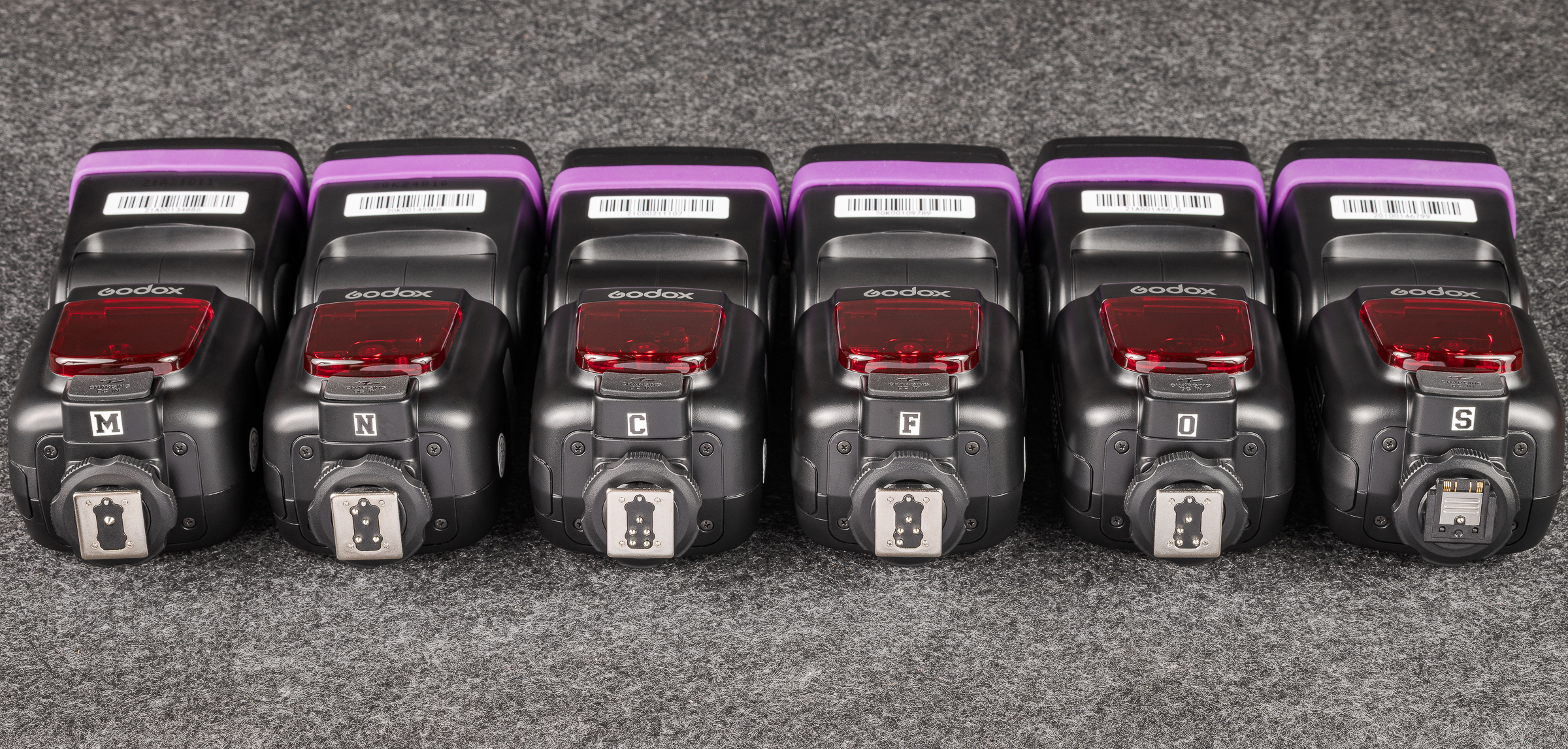
-2- Godox makes versions of each model for Nikon (N), Canon (C), Sony (S), FUJIFILM (F), and Olympus/Panasonic (O). (The M flash at the left below is the TT600 pure manual flash.) These camera-specific versions allow the same full TTL compatibility as do the camera manufacturer’s flashes. They are denoted by the first letter of the camera brand as a suffix. In other words, for a Nikon camera, you would order a TT685iiN or V860iiiN or V1N. [Click on image to enlarge, then click on left arrow to return to post.]
Godox TT685 flash hot shoes for different camera brands.
-3- All of these Godox flashes can be used in full manual mode on any camera body by any manufacturer—except for Sony. Because of its different hot shoe design, including the position of the firing pin, flashes for Sony do not work in other camera hot shoes—even in manual mode. Likewise, flashes with hot shoes for other camera brands will not work in a Sony hot shoe, even in manual mode.
-4- That being said, Godox flashes for any camera brand will work in TTL mode as remote flashes as long as the master flash or wireless trigger in the camera hot shoe matches the camera brand.
For example, on a Nikon camera, you could use a Godox TT685iiN in i-TTL mode (which is Nikon’s brand of TTL) in the camera’s hot shoe. You could then use a second TT685ii in i-TTL, regardless of the camera body brand the flash was made for. For instance, a TT685iiC (designed for e-TTL in Canon cameras) would work in Nikon’s i-TTL when used as a remote as long as a TT685iiN, V850iiiN, V1N, or wireless trigger for Nikon was in the hot shoe as the master or controller flash or trigger. That’s pretty remarkable. I highly recommend you buy all your flashes for your camera body brand, but you might be able to borrow Godox flashes for other camera brands from colleagues for additional off-camera flash setups.
-5- In Manual mode, flash power can be adjusted in tenths of a stop. In TTL mode, the flash exposure compensation can be adjusted in thirds of a stop.
-6- Both the TT685ii and the V860iii have the same specs as the top-of-the-line flashes by most of the camera manufacturers, with Guide Numbers of 197 feet (60 meters) at ISO 100. The V1 specs are given in Watt-seconds (like studio strobes) instead of Guide Numbers. My experience is that the power outputs of the three models are similar.
-7- All of these models can be used as remotes in optic mode with any other flash or studio strobe. I routinely use one or more in optic mode in conjunction with my Profoto Pro-B3 studio lights. Optic mode only works in manual flash mode.
-8- In the TTL mode of any manufacturer’s flash, the flash exposure compensation is recalculated with each shutter click. This is desirable when the flash-to-subject distance is changing. But it can lead to inconsistent exposures when the distance doesn’t change.
These flashes all have a very handy TCM button that converts the TTL flash compensation into manual flash power. This allows for the camera and flash to calculate the proper flash compensation in TTL mode, but then to switch to manual mode to ensure the flash exposure is consistent between frames when your subject remains at the same distance from the flash.
-9- All three models cost much less than half the price of a top-of-the-line flashes by most of the camera manufacturers.
-10- The flash head of all three models can be tilted downward at -7° for close-up use and tilted backwards to 120°. All three flash heads rotate 330°.
-11- All three models come with a handy stand and a high quality case.
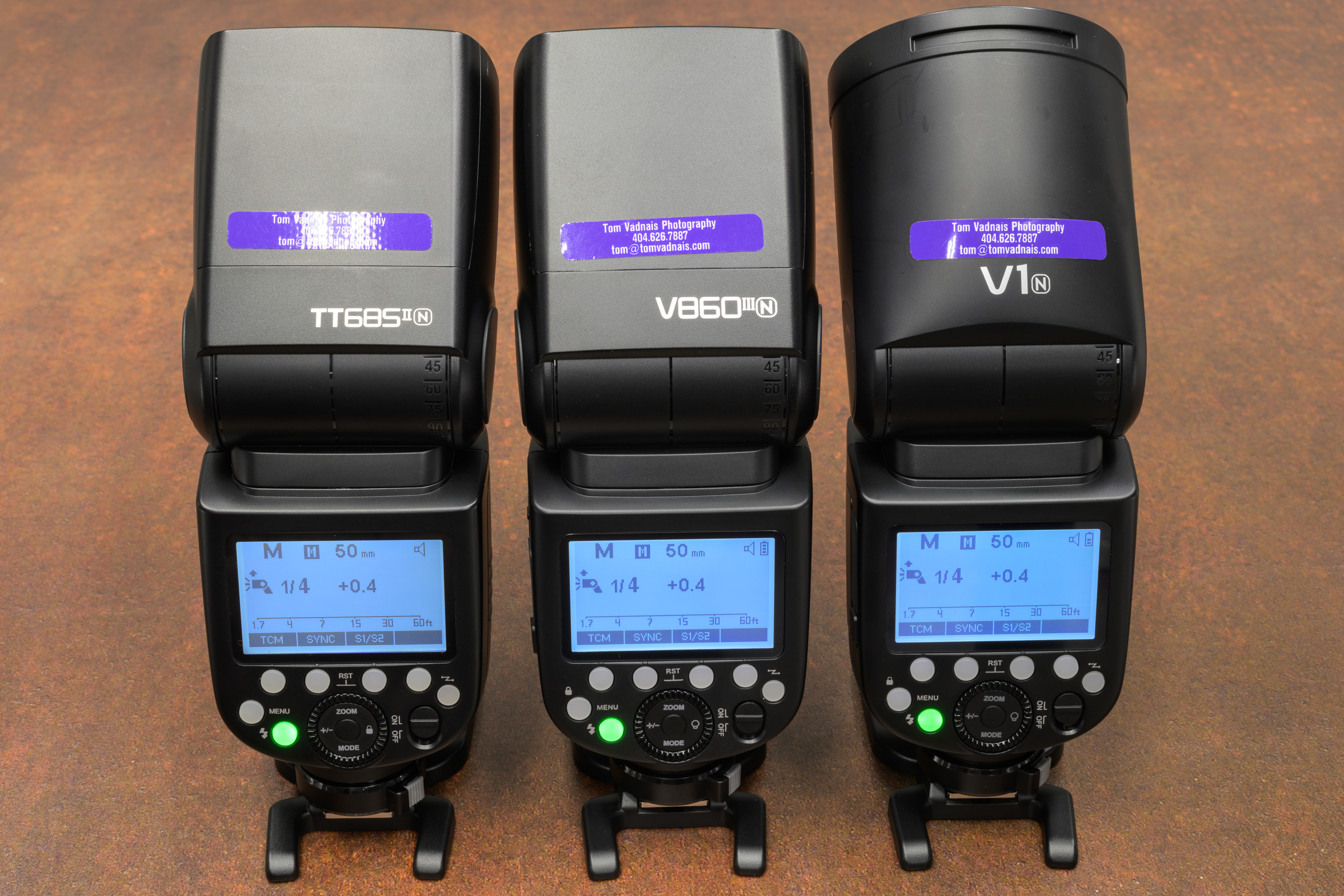
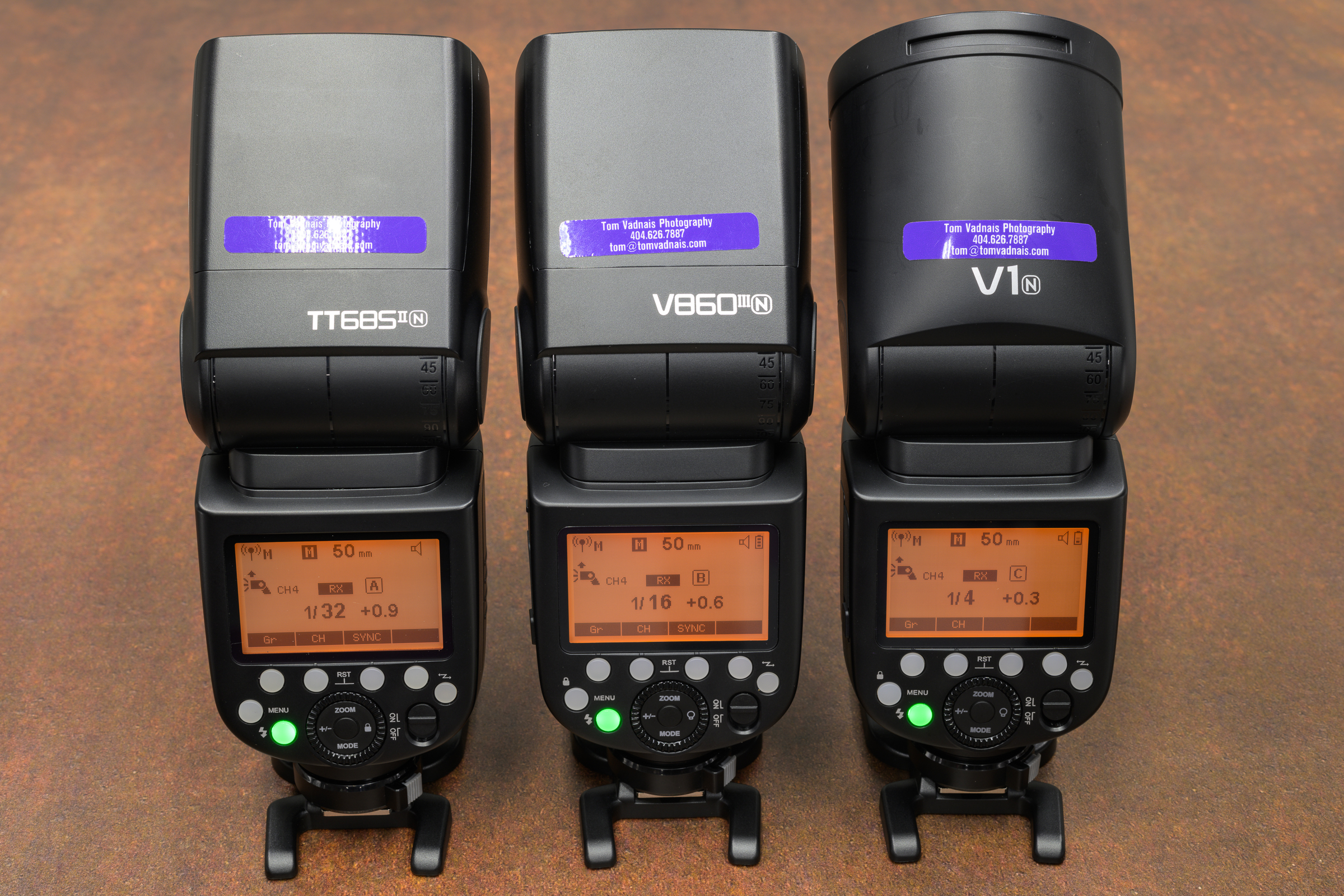
-12- All have the same intuitive interface and menu, and all are completely interchangeable in any multiple flash setup. All menus turn orange when any of the flashes is used in remote mode, which is a handy double-check. [Click on image to enlarge, then click on left arrow to return to post.]
Godox speedlite menu and interfaceGodox speedlte master menu. [Note: flash must be mounted in a camera hot shoe to function as a master flash.]Godox speedlite remote menu
Differences between models
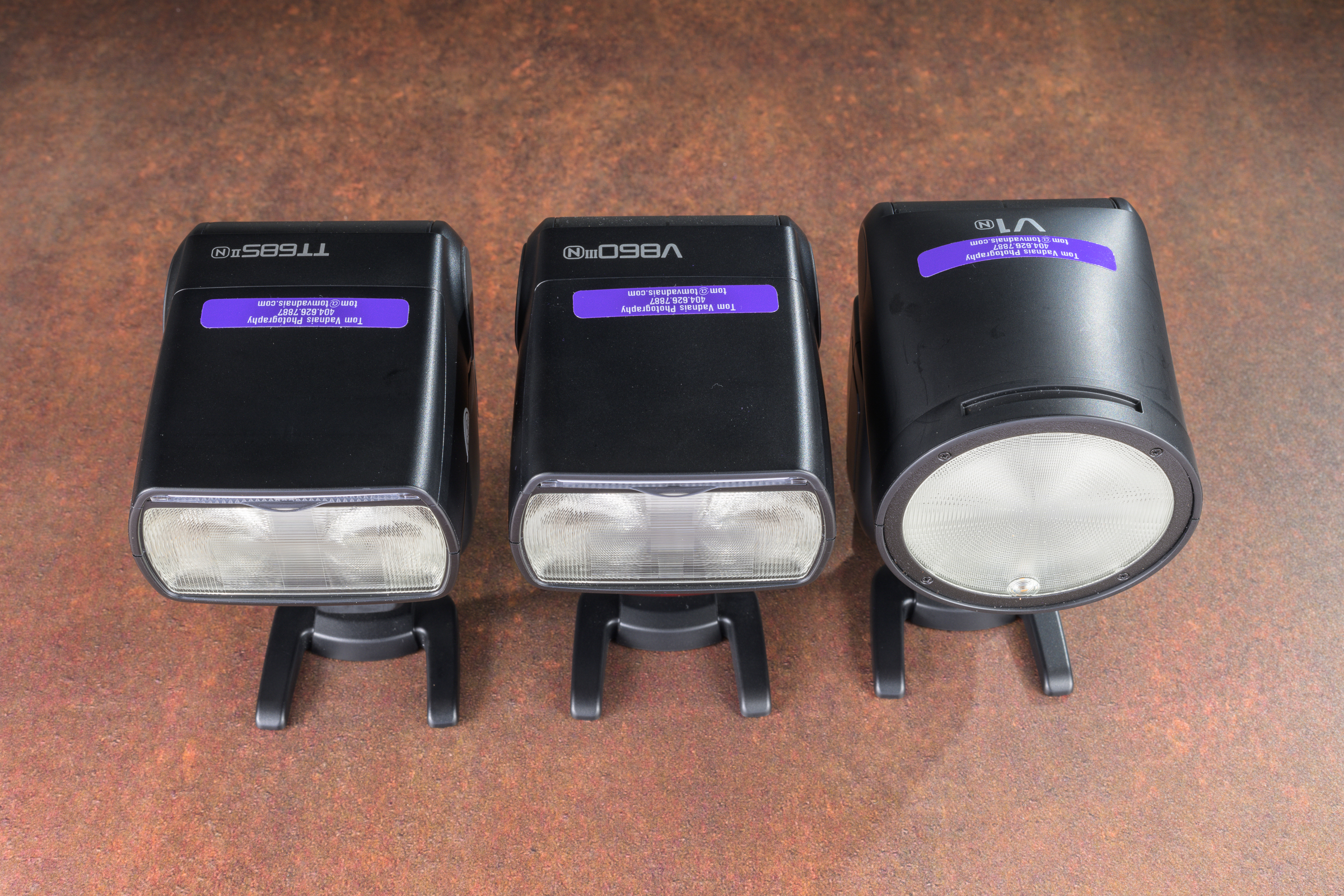
-1- The most obvious difference is that the TT685ii and the V860iii have the same rectangular head, while the V1 has a round head. The shape of the head obviously affects the shape of the light output (and perhaps the catch light in a person’s eyes), but I’ve not experienced any meaningful differences in forensic use. In fact, my studio strobes are Profoto B3 Pro lights with round heads, while my most-used speedlite is the rectangular-headed TT685ii. Depending on the amount of light needed, I not only use them interchangeably, but I often use them together for a single image. [Click on image to enlarge, then click on left arrow to return to post.]
Godox speedlite flash head shapes
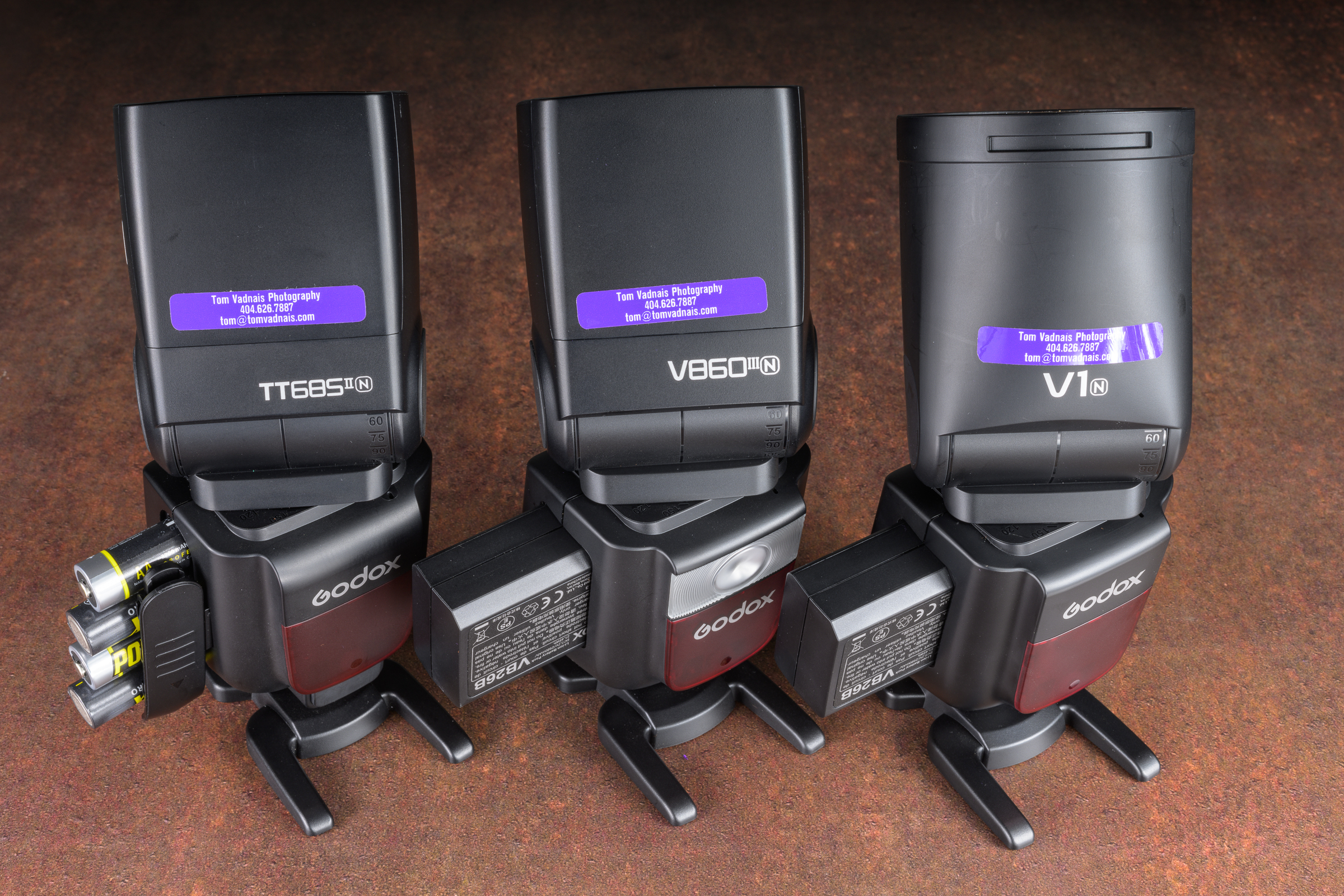
-2- Both the V860iii and V1 use proprietary lithium ion batteries. They come with one battery, but I highly suggest you buy a second for each flash to make sure you can finish your job.
The TT685ii uses four AA batteries (I’ve used Powerex Pro 2700 mAh rechargeable batteries for years). They are also compatible with external power packs for fast recharging and an almost unlimited number of flashes.
Depending on what I’m doing, I carry at least three TT685iiN flashes plus four sets of four AA rechargeable batteries between two small Think Tank battery pouches. They don’t weigh much and don’t take up much space. Best of all, if you’re out working and run out of batteries, including spares (I never have, but just in case), you can always use any universally available AA batteries. [Click on image to enlarge, then click on left arrow to return to post.]
Godox speedlite batteries with flashes on stands.
-3- Both the TT685ii and V860iii zoom from 20° to 200°, while the V1 zoom range is 28° to 105°. I use the zoom feature often to control the spread of light.
-4- The V860iii and V1 have an available modeling light, which the TT685ii lacks. I’ve never used a modeling light on studio strobes or speedlites, but if you do, this could be a deciding factor.
Please feel free to contact me if you have any questions. Happy flash shooting!